
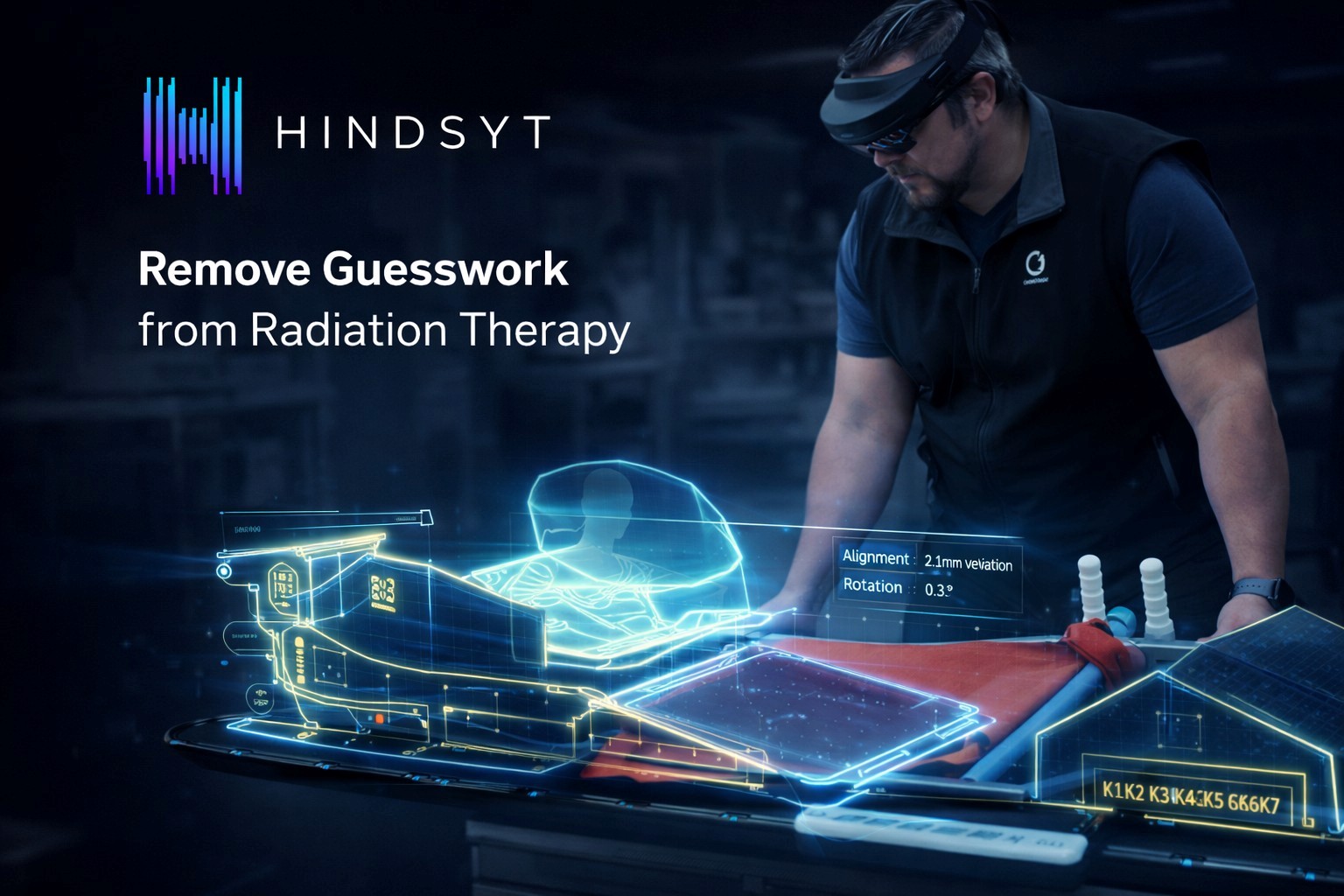
Years ago, Andrew witnessed a patient treated incorrectly after they were positioned incorrectly to receive radiotherapy due to omitted setup information - an error that stayed with him. Today, that moment has evolved into Hindsyt, a mixed reality platform backed by cancer centres, RMIT University, and Microsoft, tackling one of oncology’s most persistent challenges: human error in patient positioning.
The clinical problem
In radiation oncology, therapists position patients using tattoos, measurements, CT images, and written notes. It sounds routine - but in this field, millimetres matter. Even a 2 millimetre setup error, repeated over weeks, can shift radiation dose away from a tumour and into healthy tissue.
Andrew experienced this firsthand at a Melbourne cancer centre:
“Earlier in my career, I was involved in a patient treatment incident where important setup information had been omitted… That experience has stayed with me.”
Despite advances in radiation delivery, the setup process remains highly manual - dependent on interpretation, memory, and fragmented information.
Hindsyt’s core idea is simple: capture a precise spatial reference of the patient during simulation, then guide clinicians during treatment using mixed reality. Instead of relying on screens and notes, therapists see real-time, line-of-sight positioning guidance directly in the room.
The goal isn’t to replace clinicians but to remove guesswork at the point of care.
From idea to AUSCEP
Andrew didn’t start with a fully formed solution - just a question: “This should exist. But what does it actually look like?”
That question led him to join AUSCEP, a program designed for clinicians building solutions from real-world problems.
“The biggest shift was realising that a good clinical idea isn’t enough. Healthcare doesn’t adopt innovations because they’re better - it adopts them because they fit into workflows, have evidence, and make sense commercially, explained Andrew.
Throughout his AUSCEP journey, he began thinking beyond the idea:
This reframing turned Hindsyt from a concept into a viable venture.
More than technology
What began as a tool for improving positioning accuracy has evolved into a broader spatial clinical decision support platform.
Using a Microsoft HoloLens headset, Hindsyt creates a digital twin of the patient from CT simulation data. Real-time tracking then shows therapists exactly where the patient is versus where they should be, with holographic overlays guiding adjustments.
The system doesn’t make decisions; it provides precise spatial insight, allowing clinicians to act with greater confidence.
Early results from pilot site testing show:
Building and validating a clinical grade system
Turning this into a clinical-grade system required solving a key challenge: spatial accuracy.
“You can’t just place a hologram in a room, it has to be accurate to the millimetre - and work reliably in a clinical environment,” said Andrew.
Equally important was ensuring the system integrates into existing workflows without adding friction.
Progress has been driven by a number of key partnerships:
Funding has evolved from early personal capital to accelerator programs, with larger grants and venture funding now in progress.
“We’re not figuring out what to do next, as we know the roadmap. Now it’s about execution,”said Andrew.
The reality of medtech
One of the hardest lessons has been understanding that funding follows proof - not vision.
Investors expect:
At the same time, Andrew continues working clinically while building the company.
“Passion gets you started,” he says. “Structure helps you survive.”
What’s next
Hindsyt’s long-term vision is to move beyond static imaging toward continuous spatial intelligence - where patient anatomy and positioning are tracked in real time, enabling more adaptive and precise treatment.
For now, the focus is clear:
“Medtech moves slowly, but a clear pathway reduces uncertainty. We know what needs to happen next.”
Andrew’s lessons for other clinical entrepreneurs
When clinicians innovate, they often lack the business literacy to move from "this should exist" to "this will be adopted."

.png)